The History of Cinema: From Silent Films to Modern Blockbusters

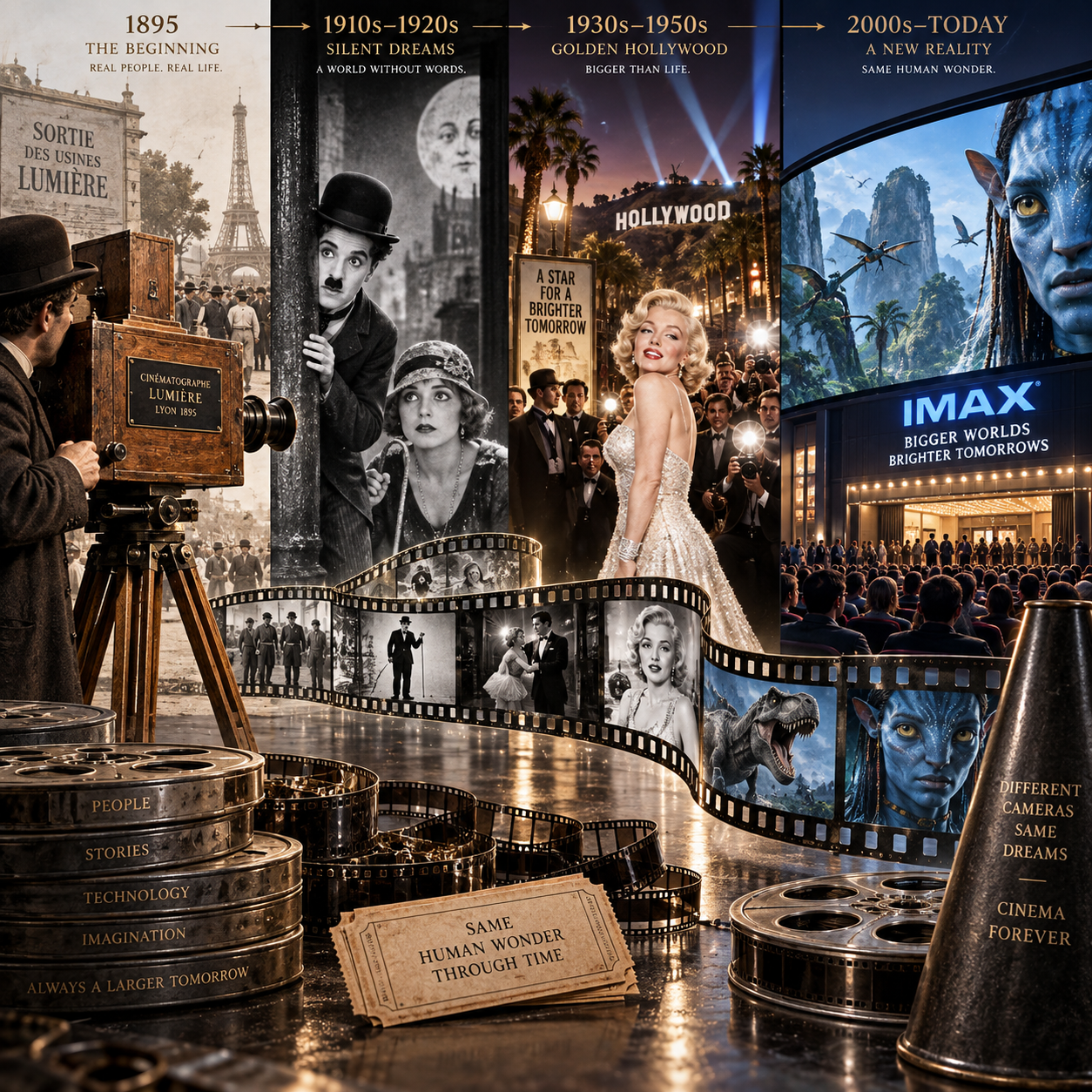
Cinema began with short, flickering images shown to curious crowds. More than a century later, films fill giant screens with digital worlds, surround sound, and computer-generated imagery (CGI). The history of cinema is therefore a story of technical invention, artistic experimentation, business change, and evolving audience habits.
Each era solved a different problem. Early filmmakers learned how to record movement; silent-film artists discovered visual storytelling; sound transformed performance; color and widescreen expanded spectacle; and digital filmmaking made previously impossible images part of everyday moviegoing. Modern blockbusters still depend on many of those early discoveries.
The Birth of Cinema and Early Film Experiments
Cinema emerged when inventors learned to capture and project a rapid sequence of images, turning recorded movement into a shared public experience. Early film was short and simple, but it established the basic relationship between camera, screen, performer, and audience.
The technology developed from earlier optical toys, photography, and scientific studies of motion. Devices such as the zoetrope created the illusion of movement by displaying still pictures in quick succession. Improvements in flexible film stock, cameras, and projection eventually made longer public screenings possible.
The Lumière brothers, Auguste and Louis, became central figures in this transition. Their Cinématographe combined camera, printer, and projector in one relatively portable machine. Their films often showed ordinary moments: workers leaving a factory, a train arriving, or people enjoying a day outdoors. These brief scenes fascinated viewers because they preserved real movement with striking immediacy.
Georges Méliès took cinema in another direction. A magician and theater showman, he recognized that film could create imaginary events rather than simply document reality. Through stop-camera tricks, painted scenery, multiple exposures, and stage-inspired design, Méliès built fantasy worlds and impossible transformations. His work helped establish editing and special effects as tools for storytelling.
Early cinema developed across several countries, including France, Britain, the United States, Germany, Italy, Japan, and Russia. Traveling exhibitors brought films to audiences who might watch them in theaters, fairgrounds, salons, or temporary venues. The screen quickly became both a novelty and a new form of popular entertainment.
The Silent Film Era: Visual Storytelling Takes Center Stage
The silent film era relied on images, gesture, editing, music, and title cards to communicate stories without synchronized spoken dialogue. Far from being artistically limited, silent cinema developed a sophisticated visual language that still shapes filmmaking today.
Actors learned to make emotions readable from a distance. A raised eyebrow, a hurried movement, or a carefully framed reaction could clarify a character’s thoughts. Performances were often more physically expressive than modern screen acting because projection equipment could not reproduce voices and dialogue in the theater.
Title cards supplied essential dialogue, exposition, and jokes, but filmmakers did not place them after every line. Effective silent films balanced written information with visual action. Editors discovered that cutting between locations could create suspense, parallel stories, and a sense of simultaneous events.
Comedy became one of the era’s most accessible genres. Performers such as Charlie Chaplin, Buster Keaton, and Harold Lloyd built humor around timing, physical danger, social embarrassment, and inventive use of space. Their films could travel across language barriers because the central jokes depended on movement and situation.
Drama and epic storytelling also expanded. Filmmakers experimented with close-ups, large crowd scenes, elaborate sets, and symbolic imagery. The growing popularity of cinema created a new culture of movie stars, whose faces and public personas attracted audiences from one film to the next.
Musicians played an important role in the silent-film experience. A pianist, organist, or small ensemble could match the mood of a scene, build tension, or soften a tragic moment. The film was silent in a technical sense, yet screenings were rarely quiet.
The Arrival of Sound and the Transformation of Hollywood
Sound film changed cinema by synchronizing recorded dialogue, music, and effects with moving images. It altered acting, scriptwriting, editing, theater design, and the commercial structure of the film industry.
Early sound systems required cameras and microphones to work within strict limits. Actors sometimes had to remain close to hidden microphones, while noisy cameras were enclosed in soundproof booths. The visual freedom of silent cinema temporarily narrowed as filmmakers adjusted to the new equipment.
Audiences embraced synchronized speech because voices made characters feel immediate and individual. Dialogue-driven genres, including the musical, gangster film, and screwball comedy, gained new possibilities. Songs and memorable lines also became powerful promotional tools.
The change carried costs. Some silent stars struggled with unfamiliar voices, accents, or acting styles, while others adapted successfully. International cinema faced another complication: films now needed subtitles, dubbing, or separate language versions. Sound made movies more realistic for some viewers, but it also reduced the universal portability that silent images had enjoyed.
In the United States, sound accelerated the power of the Hollywood studio system. Major studios controlled production, distribution, and theater bookings, creating an industrial model that could manage expensive sound equipment and large-scale releases. Studios developed stable production departments, long-term contracts, recognizable genres, and carefully marketed stars.
Hollywood was influential, but it was not alone. European, Soviet, Indian, Japanese, Chinese, and Latin American filmmakers developed distinctive sound traditions. National languages and local storytelling customs shaped how synchronized dialogue changed cinema around the world.
Color, Widescreen, and the Expansion of Film Genres
Color cinematography and widescreen formats expanded the visual possibilities of film, helping filmmakers create richer worlds and more spectacular genres. These technologies attracted audiences while television and other forms of home entertainment competed for their attention.
Early color processes were expensive and technically demanding. Over time, improved systems made color more practical for mainstream production. Color could establish mood, distinguish fantasy from reality, signal danger, or make costumes and landscapes central to the story.
Widescreen presentations increased the scale of the image. Large formats and theatrical sound systems encouraged filmmakers to emphasize landscapes, choreography, battles, architecture, and vast crowds. The screen became an event in itself, especially for historical epics, biblical dramas, westerns, and science fiction.
Genres matured during this period. Musicals used color and widescreen to turn dance into moving architecture. Horror films exploited shadows, makeup, sound, and production design. Westerns transformed open landscapes into moral and psychological spaces, while science fiction presented technological anxiety and visions of other worlds.
Technical progress, however, did not guarantee better storytelling. A spectacular image could attract attention, yet memorable films also needed compelling characters, clear conflict, and purposeful visual choices. Choosing a larger format for spectacle meant accepting higher production and exhibition costs. The most effective filmmakers treated technology as part of the story rather than decoration.
From New Hollywood to the Rise of the Blockbuster
New Hollywood shifted attention toward director-driven films and ambitious young filmmakers, while the blockbuster model turned major releases into cultural events. This period connected artistic experimentation with aggressive marketing, merchandising, and international distribution.
From the late 1960s through the 1970s, changes in censorship, television competition, and audience taste created room for more unconventional American films. Directors gained greater influence over subject matter, editing, and visual style. Crime stories, psychological dramas, road movies, political films, and experimental narratives reached wider audiences.
The era also encouraged a more skeptical view of traditional heroes and institutions. Filmmakers drew inspiration from European art cinema, documentary realism, genre history, and contemporary social tensions. Hollywood was no longer defined only by the polished formulas of the studio era.
By the late 1970s and 1980s, the modern blockbuster became a dominant commercial model. A blockbuster typically combined a simple, high-concept premise with strong visual hooks, broad audience appeal, extensive advertising, and strategic release timing. The goal was to make the film feel essential before opening night.
Blockbusters changed the relationship between films and merchandise. Toys, soundtracks, video games, books, and licensed products could extend a story beyond the theater. Sequels and franchises offered studios recognizable brands and audiences familiar worlds, although heavy reliance on formulas could discourage risk-taking.
The model spread globally. International co-production, dubbing, subtitling, multiplexes, and home video helped films travel across borders. At the same time, national cinemas continued to produce local stories that followed different commercial and artistic priorities.
Digital Cinema, CGI, and the Modern Movie Experience
Digital filmmaking has transformed how movies are captured, edited, distributed, and enhanced, while CGI allows filmmakers to build characters, environments, and action beyond practical limits. Modern blockbusters combine these tools with older principles of framing, performance, editing, and dramatic structure.
Digital cameras can reduce the cost of shooting and make it easier to review footage immediately. Nonlinear editing systems let filmmakers rearrange scenes, test pacing, and combine live action with visual effects. Digital projection has also replaced much traditional photochemical distribution in theaters.
CGI supports many kinds of work, from invisible environmental changes to fully digital creatures and locations. It can extend a set, remove an object, simulate destruction, or create an entire fictional universe. The strongest effects usually support the story so smoothly that viewers notice the character’s goal before noticing the technology.
Contemporary blockbusters often rely on franchise storytelling. Superhero universes, fantasy adaptations, science-fiction series, and animated properties encourage audiences to follow connected narratives across multiple films and platforms. This creates continuity and anticipation, but it can make individual entries feel like chapters in a larger business strategy rather than complete stories.
Streaming has changed the movie experience again. Viewers can watch films at home, on mobile devices, or through subscription libraries, while theaters compete through premium screens, immersive sound, event releases, and communal viewing. The trade-off is clear: home access offers convenience and variety, whereas theatrical presentation provides scale and shared attention.
Modern cinema is therefore hybrid. Practical sets coexist with virtual production, film festivals exist beside global streaming platforms, and intimate dramas share a marketplace with effects-heavy spectacles. Digital tools have widened the range of possible images, but they have not removed the need for structure, emotion, or a reason for the audience to care.
Why Cinema’s History Still Matters
The history of cinema matters because every modern film inherits techniques, business models, and audience expectations developed by earlier generations. The close-up recalls silent cinema’s visual emphasis; synchronized sound continues the revolution of the sound film; color, widescreen, and CGI extend the pursuit of spectacle.
Studying film history also prevents a narrow definition of progress. New technology can expand creative choices, but artistic breakthroughs often come from constraints. Silent filmmakers invented visual solutions because they lacked spoken dialogue. New Hollywood directors found fresh voices by challenging established formulas. Digital artists continue that process with tools that make production more flexible while creating new aesthetic problems.
A useful way to understand cinema is through three connected forces: the image, which shapes what audiences see; the industry, which determines how films are financed and distributed; and the audience, whose habits influence what survives. Every major transition changes all three.
The journey from the Lumière brothers to the modern blockbuster is not a straight march from simple pictures to superior technology. It is a continuing conversation between invention and expression. A flickering silent image, a carefully mixed soundtrack, a widescreen landscape, and a digital creature all serve the same enduring purpose: making an audience believe, for a while, in a world beyond the theater.
Frequently Asked Questions About Cinema History
What was the first era of cinema like?
The first era of cinema featured short films shown in temporary venues and early theaters. Many films documented everyday life, while others used staged scenes, comedy, trick effects, and simple narrative situations.
Why did silent films use title cards?
Silent films used title cards to present dialogue, explain plot information, identify time or place, and deliver jokes. They worked alongside acting, editing, music, and visual composition.
How did sound change movies?
Sound introduced synchronized dialogue, music, and effects. It changed performance styles, scripts, editing, theater equipment, international distribution, and the economics of the Hollywood studio system.
When did blockbusters become a dominant film model?
Blockbusters became a dominant commercial model during the late 1970s and 1980s, when high-concept stories, major advertising campaigns, merchandising, sequels, and wide releases became closely connected.
How has digital technology changed filmmaking?
Digital technology has made production and editing more flexible, simplified distribution, and expanded visual effects. CGI and virtual production can create images that would be difficult, dangerous, or impossible to capture practically.